|
The economics of mosquito management The annoyance caused by
mosquitoes can be documented in terms of economic loss. Coastal towns that
enjoy increased population during the summer months, and income from
recreational activities and tourism, experience significant reductions when
mosquito breeding goes unchecked. Economic injury levels occurred at
Hammonassett State Park in Madison, CT during the summer of 1994 when the
mosquito population became so insidious it sent park visitors fleeing.
Demands for admission and camping fee refunds prompted park authorities to
respond with emergency spraying of the beach and camping areas. Estimated annual
expenditures of mosquito control agencies in the U.S. and Canada exceed $80
million. This is more than matched by consumer purchases of aerosol
insecticides, repellants, protective screens and other controls.
Unfortunately, the largest portion of these resources is directed toward
ineffectual control methods and serves only to put more toxic materials in
the environment. Furthermore, these efforts often result in new problems,
such as outbreaks of pests of shade and forest trees, when mosquito control
activities kill the organisms that normally keep the pests under natural
control. The wasted money and time
and the annoying or potentially dangerous side effects result because much of
the control effort is directed against the adult mosquito instead of going to
the source: the water where the larval
stages of the mosquito are found.
Surprisingly, routine spraying and fogging with toxic chemical
insecticides still occurs, even though source reduction techniques have been
taught for decades. Although the spraying of insecticides that reduce adult
mosquito populations can be an excellent emergency procedure, it is
imperative that the spraying be followed with source reduction measures and
the application of larvicides. Safe and effective mosquito control requires
more attention, time and effort than the traditional “spray and hope”
approach. |
|
Economics
of Mosquito Management |
|
Safe and effective mosquito control
requires more attention, time and effort than the traditional “spray and
hope” approach. |
|
To contact us: |
|
Phone: (203)
245-7015 Email:
info@innovativemosquito.com |
|
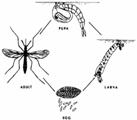
Aedes Life-Cycle |